EAST SOS Team Members Speak About russian Crimes They Experienced Firsthand
russia’s war against Ukraine has left thousands of people victims and witnesses of war crimes. Those who survived occupation, shelling, filtration, torture, or the loss of loved ones often keep silent because they are afraid, exhausted, or convinced that their story will not change anything. But personal testimonies are exactly what make it possible to document war crimes, ensure accountability, and preserve the truth about the war started by russia.
This collection includes testimonies from members of the EAST SOS team. Among them are war crimes documenters, evacuation workers, managers, and coordinators who not only record the consequences of russian aggression but have also personally experienced occupation, shelling, humanitarian disasters, and violence. Their stories remind us that every person affected by the war has the right and the opportunity to testify about the crimes of the aggressor state.
- The First Shahed Attacks on Kyiv Oblast and the Risks Children Face When Studying in the Temporarily Occupied Territories
Education Program Manager Mykola Overchenko spoke about the first attacks on Ukraine using Shahed UAVs. In 2022, Mykola was working as a teacher at a school in Vyshhorod Raion, Kyiv Oblast:
“The Shaheds came in the autumn, because I was still teaching at that school. In October 2022, when the first Shaheds were flying toward Kyiv, they flew right over us. We saw them, and those missiles that were flying toward Kyiv passed over us too. There were explosions, air defense was working, and there were strikes in the neighboring hromada (community).”
In 2026, Mykola continues teaching students who are in the temporarily occupied territories, so he is aware of the personal tragedy of each child:
“It is dangerous. Children and their parents in the temporarily occupied territories face criminal liability for studying at a Ukrainian online school [russia unlawfully imposes criminal liability on them under its own laws – Ed.]. This threatens their lives and health. If the russians find out that they attend a Ukrainian school, they face criminal liability, so every lesson is dangerous for them. In my hometown of Berdiansk, as well as in Melitopol, they have set up an organization called “Yug Molodoy” [Young South, a russian occupation youth movement] to actively recruit young people. Of course, there are also the “Orlyata” [Eaglets, a state-run program for younger children], the classic “Yunarmiya” [Young Army, a russian paramilitary youth organization], and those so-called “desks of heroes” [a russian state education initiative where school desks are dedicated to fallen russian soldiers].”
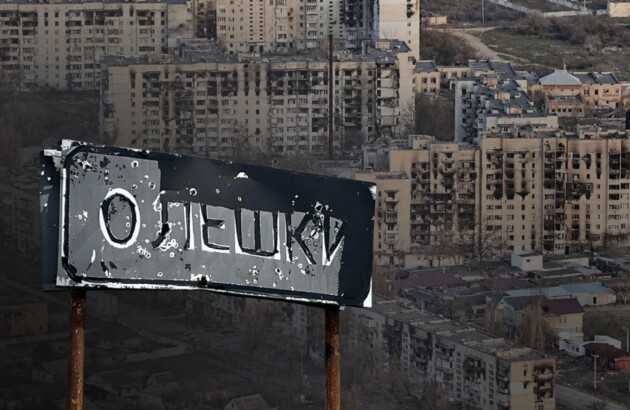
- Environmental Consequences of russian Shelling in Kurakhove
Advocacy specialist Yaroslav Taranets shared that regular russian shelling has effectively caused an environmental disaster in his hometown Kurakhove, Donetsk Oblast:
“russian troops damaged the dam of the Kurakhove Reservoir, causing significant harm to the environment. The reservoir was heavily stocked with fish. It was not only the reservoir; the Vovcha River, a tributary of the Siverskyi Donets, is also there. Locally, fishing was very developed; the pond was deliberately stocked with fish. Entire schools of silver carp used to swim there. When you approached, they would jump out of the water. There were so many fish, so many crayfish. The city was famous for its crayfish; there were unbelievably many of them. When you drove through the private residential area where people lived near the river and near the reservoir, there were always signs along the road: crayfish, crayfish, crayfish, crayfish. russian shelling devastated the environment.”
- russian Troops Shot at a Civilian Car in Kherson Oblast
In 2022, Regional Manager Yuliia Chokas experienced the occupation of Kherson and has spoken out about this deeply challenging experience. russian troops shot up the car of a close friend of hers:
“On March 16, 2022, russian troops shot up the car of my friend. His agricultural base was located in Bilozerka, near Kherson. He decided to check the equipment. The roads were blocked, so he had to drive around. He drove through a field and saw two soldiers with assault rifles aiming at him. He stopped the car, turned on the hazard lights, and raised his hands. But that did not save him. russian troops opened fire. He was in the car with his father. He managed to react quickly, turn around, and drive in another direction. The fuel tank was shot through, the tires were shot through. He had two bullet wounds: one in his arm and one below the neck. Local residents met them and took them to the hospital. We saw the car – it was all covered in bullet holes. The russians took away the grain and equipment that had been stored there.”
During the occupation, the situation with food in the city was difficult:
“They started bringing food into Kherson from russia, but it was much more expensive.”
russian troops regularly carried out searches in the city:
“russian troops stopped civilians to check documents. We were going to the market to buy food, and they stopped us for a document check. Several armed soldiers arrived, entered the yard, and walked around the courtyard of a private house.”
At the same time, russian invaders were kidnapping civilians and torturing them:
“russian troops took my friend’s grandfather. He had gone outside too early during curfew. They released him a few days later after beating him. However, they only let him go because they were afraid, he would die “in the basement.”
“russian troops broke the locks on the property owned by my family and opened their own pharmacy there. Later, during one of the russian shellings of Kherson after the city was liberated, the building was almost completely destroyed.”
- russian Missile Strike on Pokrovsk
Monitoring and Evaluation Analyst Ihor Chelter spoke about the russian attack on the Druzhba Hotel in Pokrovsk, Donetsk Oblast, which he witnessed. At the time of the attack, Ihor was 10 minutes away from the hotel:
“It was August 2023, and it was a big tragedy. Two Iskander missiles hit the hotel and an apartment building. The first missile struck a civilian building. Many people were injured, and the State Emergency Service teams went there. About 40 minutes later, the second missile hit the Druzhba Hotel. A cluster munition was used that day. They began using this tactic to cause as many casualties as possible.”
- Humiliation and Sexualized Threats During Checks at So-Called “dpr” Checkpoints
War Crimes Documenter Kateryna Kaliuzhna described a check carried out by “militants” of the so-called “dpr”:
“They stopped our bus, and everyone got out for a document check. A soldier came up to me and started asking why I was studying in Mariupol. I had to explain what I was doing in Mariupol with Makiivka residence registration. He took my passport and asked whether I was married. I said no. Then he started convincing me that it was “already time.” I was 20 years old then. After that, he said everyone should get back on the bus, but I had to stay. It was already getting dark, and there were armed people around who had been drinking. I asked what the problem was, and he said: “We’ll find you a husband now.” I was lucky that a woman around 50–55 was traveling next to me. She ran out of the bus saying I was her niece and that people were waiting for us. Then they let me go.”
If you witnessed or suffered from unlawful actions by russia, please contact the EAST SOS call center: 0800 332 614 (Mon-Sat, 8:00 AM to 6:00 PM). Reports are also accepted by email: [email protected].