The Day of Prevention of Violence Against Children: East SOS Highlights Crimes Against Ukrainian Children in the Temporarily Occupied Territories
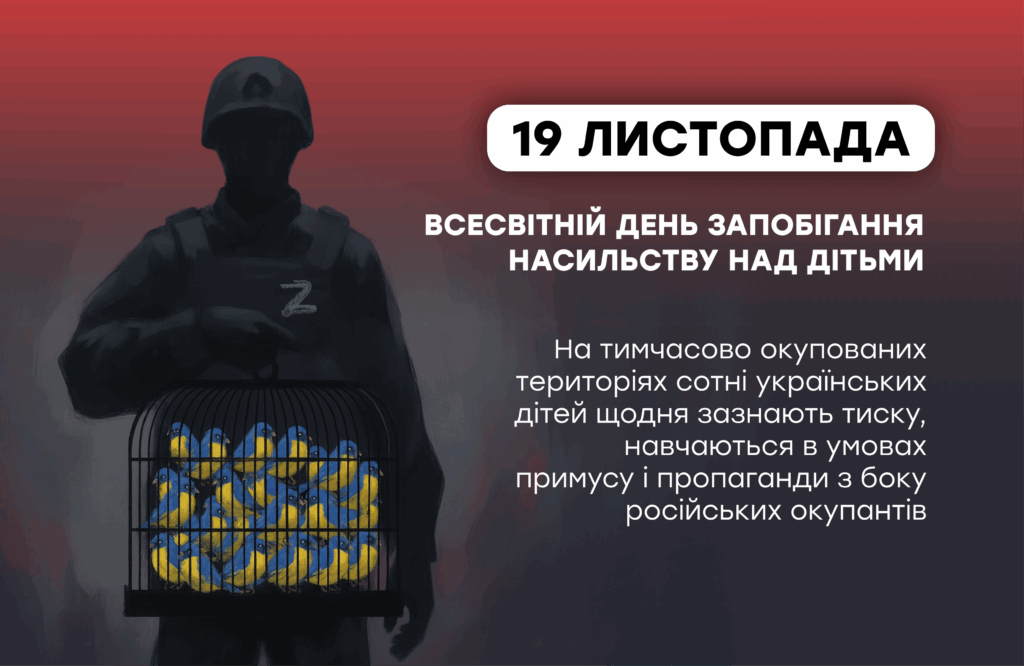
The militarization of the education system in the temporarily occupied territories (TOT) is part of russia’s broader strategy to reshape the social environment, demographic composition, and identity of the population. Children – one of the most vulnerable groups – have become a key target of this policy, as they will define the future social and political landscape of these regions. Educational institutions in the TOT are being transformed into instruments of political control, indoctrination (the targeted and systematic imposition of specific political narratives), and the creation of a “loyal” generation aligned with the interests of the occupying power.
The militarization of education unfolds across several interconnected levels: the introduction of curriculum courses intended to legitimize the war; the institutionalization of “military-patriotic education”; the involvement of children in paramilitary movements; and the systematic presence of armed groups within the educational process.
The “Young Army” is the largest russian military-patriotic organization operating in the temporarily occupied territories. It employs a wide range of practices aimed at russification and the forced transformation of Ukrainian children’s identity. Its activities focus on military sports and tactical training, including drill, marching, general tactics, camouflage, shooting exercises, and participation in military-sports games such as Zarnitsa and Orlyonok. Children also undergo military field training modeled on the practices of russian army units. These activities are systematically embedded into the educational process through so-called “lessons of courage” and other militarized, ideological subjects. Children are regularly involved in lectures and “educational hours” built on historical propaganda, meetings with russian military personnel, visits to “special military operation (SMO) museums,” and exhibitions of captured equipment. Participation in mass events that legitimize the occupation has become routine: rallies, parades, russian flag-raising ceremonies, and celebrations of russian state holidays. In October of this year, the occupation authorities opened the so-called “House of the Young Army” in Mariupol, where, during staged celebrations, russian soldiers taught children battlefield tactics [1].
A recent example is the preparation of “special reports” by children about the so-called heroes of russia fighting against Ukraine. These videos draw direct parallels between the Soviet-German war and the current russian-Ukrainian war, claiming that, just as decades ago, the russian military is once again combating a “Nazi threat” [2].
As part of the Young Army’s activities, children from the temporarily occupied territories continue to be actively taken on tours to russia. The core theme of such trips remains unchanged – a staged “historical journey” to sites of the so-called military glory of the russian federation [3]. In addition to glorifying russian soldiers during the propagandistic “Conversations about Important Things,” students are required to prepare special homework assignments about “heroes” of the russian Ministry of Internal Affairs [4]. The russian military is also routinely involved in Young Army events. One common format includes a performance by a military band, followed by a lesson in which children are taught the history of the regiment and receive another so-called “lesson of courage” [5].
Volodymyr (name changed for security reasons), who has been studying under temporary occupation in the Donetsk region since 2014, told the East SOS documentary team about the activities of the Young Army:
“[In the Young Army] we had to take care of the posters – the military-patriotic ones – and we had to prepare some kind of performance. It felt like the Soviet Union.”
He noted that participation in the military-patriotic organization effectively guaranteed higher grades:
“People who took part in this [in the Young Army] were given good marks and treated favorably. Otherwise – if you didn’t participate – there was another way out: you could be very active in class, answer questions, and then you would get your grades.”
Most of the “Conversations About Important Things” were conducted by teachers. One teacher, who was forced to remain for some time in the temporarily occupied Luhansk region in 2022, described how these lessons were organized:
“We were introduced to the ‘Conversations About Important Things’ program for educational work. The program is based on a specific calendar curriculum, with prescribed methodologies and presentations. In other words, you are given all the materials and you have to voice them. You cannot add or remove anything. The program contains complex moral and ethical topics; there are very sensitive issues: ‘homeland,’ ‘who is a friend, who is an enemy?’ This is the kind of content that, if properly delivered and planted into an immature child’s mind, can produce certain results.”
The teaching staff of schools in the temporarily occupied territories (TOT) often includes veterans of the so-called SMO. One example is Dmytro Tkachenko, a teacher at Donetsk Lyceum No. 37, who previously fought against Ukraine in Mariupol and Mariinka. Evidently, one of the roles performed by such “teachers” is the recruitment of young people from the TOT into the russian armed forces. According to russian propaganda sources, some of the graduates taught by Tkachenko are already participating in hostilities [6].
russia is also actively expanding its education system in the TOT through the “Zemskyi Teacher” program. According to open sources, 15 “zemskyi” teachers are currently working in the so-called LNR [7]. While statistics for the so-called DNR are unavailable, it is known that the program is being actively implemented there as well: in 2025, three russian teachers joined the quasi-state structures [8]. The program has also been launched in the Kherson region, where russia has recruited two teachers [9]. This demonstrates that the russification of education in the TOT is not a stable or one-time occurrence, but a process that is accelerating each month. By 2028, the russian federation plans to deploy six more “zemskyi” teachers to schools in the Kherson region [10]. Furthermore, starting January 1, 2025, “zemskyi teachers” working in temporarily occupied Ukrainian territories will receive a payment of 2 million rubles – twice the amount provided for the same work within russia itself.
Any event organized by the russian occupation administration in the TOT is easily identifiable by its pronounced “military” tone. For instance, in the summer of 2025, students from art schools in the TOT were taken to study in russia, where a visit to the “Victory Museum” was a mandatory part of the “educational” program [11]. In addition, the children’s artworks were scheduled to be displayed at the exhibition “Moscow – the Hero City,” which aims to promote the “military-patriotic education of youth” [12].
Oleksandr, who has been studying under occupation in the Luhansk region since 2022, told the East SOS documentary team about how children were taken to a camp in Nyzhniy Novhorod. According to him:
“They took us to their city council, where a local deputy said: ‘We have liberated you, now you are under the protection of russia.’ I watched this and felt mad. In the camp, they forced children to raise the russian flag – even me. But I didn’t do it; I stood aside and let others do it.”
The militarization of public space is also reinforced through the renaming of schools after so-called heroes of the “SMO.” In September 2025, Donetsk School No. 115 was renamed after russian “traitor” Ivan Kokovin and American Michael Gloss, both of whom took part in hostilities against Ukraine. The latter is the son of the CIA’s deputy director, and his story has been heavily exploited by russian propagandists, who present him as an example of an “American – a great friend of russia.”
The practices described above constitute a gross violation of International Humanitarian Law (IHL). Article 50 of the Fourth Geneva Convention (1949) prohibits an Occupying Power from taking measures aimed at altering the education of children or mobilizing them into its own structures. Additionally, Article 4 of Additional Protocol II to the Geneva Conventions (1977) establishes the obligation to provide children with necessary care and assistance. According to Article 8 of the Rome Statute of the International Criminal Court, any involvement of children in the activities of military formations – including non-combatant roles – is prohibited.
The documentation of these violations by East SOS is conducted within the framework of the project “Support for War-Affected Vulnerable Populations and Residents of Remote Areas of Ukraine,” with financial support from the European Union. The content is the sole responsibility of the foundation and does not necessarily reflect the position of the EU.
[1] Mariupol City Council. Telegram. URL: https://t.me/mariupolrada/30682 (дата звернення: 14.11.2025).
[2] https://vk.com/wall-183529557_32535
[3] https://vk.com/wall-180860093_54730
[4] https://vk.com/wall-180860093_54642
[5] https://vk.com/wall-180860093_54639
[6] A special edition about defenders of the Homeland has been delivered to its destination. Rodina. URL: https://rodina-history.ru/2025/10/28/liniia-bolevogo-soprikosnoveniia.html (дата звернення: 14.11.2025).[7] There are currently 15 “Zemskyi” teachers working in the LNR. TACC. URL: https://tass.ru/obschestvo/24817377 (дата звернення: 14.11.2025).
[8] The “Zemskyi Teacher” program is actively being implemented in the DNR. БEZФОРМАТА. URL: https://donetsk.bezformata.com/listnews/zemskiy-uchitel/152286009/ (дата звернення: 14.11.2025).
[9] Teachers have begun working in the Kherson region under the “Zemskyi Teacher” program. TACC. URL: https://tass.ru/obschestvo/25237295 (дата звернення: 14.11.2025).
[10] By 2028, six additional “Zemskyi” teachers are planned to arrive in the Kherson region. БEZФОРМАТА. URL: https://herson.bezformata.com/listnews/hersonskuyu/151907644/ (дата звернення: 14.11.2025).
[11] NGO “Eurasia”. Non-profit organization for the promotion of international cooperation “Eurasia”. URL: https://evrazia.su/news/deti-iz-hudozhestvennyh-shkol-novorossii-proshli-obrazovatelnyy-intensiv-s-silneyshimi-pedagogami-moskvy (дата звернення: 14.11.2025).
[12] City of Heroes | Development Center Project | Portal of your opportunities. Development Center | Portal of your opportunities. URL: https://xn--p1al.xn--80adxhks/gorodgeroev#:~:text=«Город%20Героев»%20–%20проект%20Центра,и%20целей,%20формирует%20дружеские%20отношения. (дата звернення: 14.11.2025).