How russia Commits War Crimes in Temporarily Occupied Territories: EAST SOS Publishes Horrifying Testimonies of Ukrainians
russia’s armed aggression against Ukraine began on February 19, 2014, with the operation to seize and then occupy the Autonomous Republic of Crimea. On February 24, 2026, Ukraine marked four years since the beginning of russia’s full-scale invasion – a new phase of the war accompanied by systematic war crimes in the temporarily occupied territories and far beyond the front line.
Since the beginning of the war, the EAST SOS Charity Foundation has been documenting the testimonies of Ukrainians who have survived occupation, shelling, and persecution by russian forces. This article focuses on crimes committed after February 24, 2022. For security reasons, the names of the witnesses have been changed.
The siege of Mariupol was one of the greatest tragedies of Ukraine in 2022. Those who could not escape were forced to make superhuman efforts simply to survive.
“We were being killed. The bodies of the dead were left lying in the streets and then simply thrown into the sea like trash. There were body parts in the streets – an arm here, a leg there and this became part of everyday life. Our entire road, everything around us, was covered in blood. Looking out the window, all you could see was black and red. The only grey came from houses that had not burned badly but had collapsed,” recalls Mariia from Mariupol.
Since 2022, russia has been mobilizing Ukrainian men living in the so-called “DPR” and “LPR.” The occupiers have also done everything possible, and continue to do so, to force young men finishing school in the temporarily occupied territories to serve in the russian army.
“They took all of us to the military enlistment office in 10th grade. Our whole class went there to update our records. Mobilization began when I was a first-year university student. I was 17, and the other boys were 18. On February 18, 2022, mobilization was announced. And everyone who was at the university – first, second, and third-year students – absolutely everyone aged 18 to 60 was mobilized. Those who were 18 and considered fit for service received messages from the dean’s office telling them to come and collect their draft notices. Those who showed up were taken straight to the war, and that’s how a lot of people from my first year were mobilized while I was studying there. Later, some were even captured. Ukrainian media interviewed them about how they had ended up in captivity. One guy even wrote in our group chat that the russians were shelling Donetsk themselves, but nobody paid attention,” says Volodymyr from Donetsk Oblast.
Since 2022, russia has systematically persecuted Ukrainian citizens in the temporary occupied territories, conducting illegal detentions and committing violence against captured civilians.
“At the start of the full-scale invasion, the russians took my mother’s cousin, drove him out to a field, beat him, stripped him completely naked, and dumped him there. He later managed to make his way home; someone picked him up along the road. The russians also used suspension as a form of torture, tying people up by their hands in the air and leaving them without food and water for several days. This is what they are doing to my sister’s classmate because of his pro-Ukrainian position. In our town, the russians killed an entire family: they raped the woman and killed her husband and two young boys. One of the boys had his face slashed before being shot. The woman was raped for about a day, the neighbors heard her screaming and then she was killed,” recalls Kateryna from Zaporizhzhia Oblast.
The occupation administration systematically abuses Ukrainian citizens who attempt to leave the temporarily occupied territories. russians often deliberately force families with children to wait in long queues.
“A russian customs officer comes out, sees two cars with Ukrainian license plates, and says, ‘What, are there only khokhols [Translator’s note: a derogatory ethnic slur used by russians against Ukrainians] here?’ His colleagues reply, ‘Well, there are other cars over there.’ He looks over and sees Polish plates, Lithuanian plates, and some others. ‘Oh,’ he says, ‘you can go through, but let the “khokhols” wait.’ That’s exactly what their attitude toward Ukrainians is like ,” says Mykhailo from Kherson Oblast.
In 2024, russians continued to create obstacles for people crossing the border, even when families were travelling with small children:
“We had to walk two kilometers over rough stones. We were standing outside. They checked everyone’s phones. They spent a long time checking our laptop. We were standing outside in freezing weather – it was the morning of January 5, 2024. There was a small child nearby and a boy who was probably 15 or 16. At the checkpoint, the russians did not offer us anything to help us warm up. They kept checking everyone for so long that we were freezing, our teeth were chattering. There was also a girl of about seven. She was freezing and said to her mother, ‘Mum, I’m cold.’ Her mother stood there rubbing her to warm her up. We stood there for about two hours, maybe more. They could have at least let the child go somewhere inside. We were so cold, it was just unbearable,” shares Mariia from Kherson Oblast.
In June 2023, russia committed ecocide by blowing up the Kakhovka Hydroelectric Power Plant (HPP). According to Ukrainian authorities, confirmed by the Ministry of Internal Affairs, more than 30 people were killed in Ukraine-controlled territory, while more than 40 others are considered missing.
At the same time, there is no reliable data on the number of victims on the temporarily occupied left bank of Kherson Oblast: russia concealed the scale of the tragedy, restricted access for international organizations, including the UN and the Red Cross, and prevented local medical workers from recording the actual causes of death.
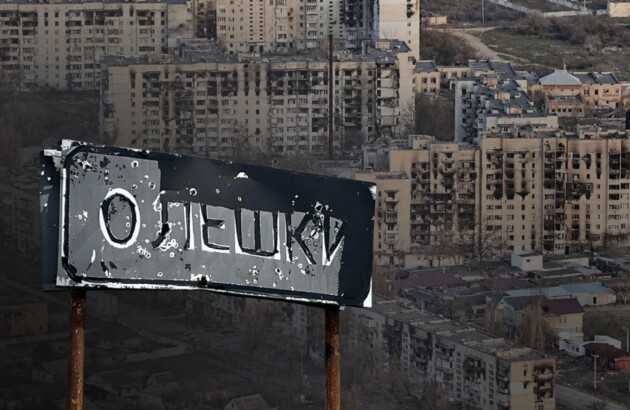
“After the Kakhovka HPP was blown up, we saw the water getting closer and closer to the house where we had been hiding from the explosions. It was a two-storey building. The house was flooded, but the water did not reach the second floor. When we left, the water was up to our chests. We headed toward a nine-story building because we knew that the water wouldn’t be able to submerge the ninth floor. We lived on the eighth floor, so we managed to make it home in time. And from there, we just watched the water keep rising higher and higher,” says Oleksandr from Oleshky, Kherson Oblast.
After russia destroyed the Kakhovka HPP, drinking water became unsafe. At the same time, russia did not provide people in the temporarily occupied territories with food or water.
“After the Kakhovka HPP was blown up, the water became really bad, completely undrinkable. There was basically nothing to purify it with, and you couldn’t purify much anyway, so people had to buy water at the store, even though it was very expensive. But what were people supposed to do? They went and bought water just to cook something basic to eat,” says Maryna from Kherson Oblast.
At the same time, russia deliberately shells civilian infrastructure in the temporarily occupied territories to then accuse the Armed Forces of Ukraine of systematic attacks.
“They could get into a boat and take a mortar along, for example. People saw it with their own eyes: they would get in, move away, and position themselves somewhere on the river – we have islands there in the floodplains. Then they would fire as if from the direction of Kherson, so the shells would fly from the right bank to the left. They would shell the area, then come there themselves, do whatever they needed to do, film whatever videos they needed, and blame the Ukrainian side,” Maryna from Kherson Oblast describes.
russian forces continue to regularly attack frontline areas using guided aerial bombs:
“Then, as the military later said, a KAB [guided aerial bomb] struck. The crater was huge. Three houses were completely leveled to the ground, and 20 others were damaged. Even houses farther away had their windows and doors blown out. Homes were damaged, and people were killed. Those who were inside their houses during the airstrike survived. But outside, it was impossible to survive. After the shelling, our yard was waist-deep in all kinds of debris and shattered roofing – everything blown off the neighboring houses,” recalls Svitlana from Donetsk Oblast.
Children who have been forced to stay in the temporarily occupied territories are trying to continue their education in Ukrainian online schools. However, since 2024, increasingly severe persecution by the occupation administration has made this exceptionally difficult.
“I couldn’t send her study materials because they check phones and all devices. When we finished the lesson, she deleted everything because she couldn’t keep any of it. This was from April to June 2024,” says Oksana, a teacher from Kherson Oblast.
Since the start of the full-scale invasion, the EAST SOS team has conducted more than 1,235 interviews and documented 2,176 alleged war crimes.
The documentation of war crimes is carried out as part of the project “Support for War-Affected Vulnerable Groups and Residents of Remote Areas of Ukraine,” funded by the European Union. The contents of this publication are the sole responsibility of the Foundation and do not necessarily reflect the views of the European Union. (European Union in Ukraine).