East SOS Presents Stories of Resilient Ukrainians on Dignity and Freedom Day
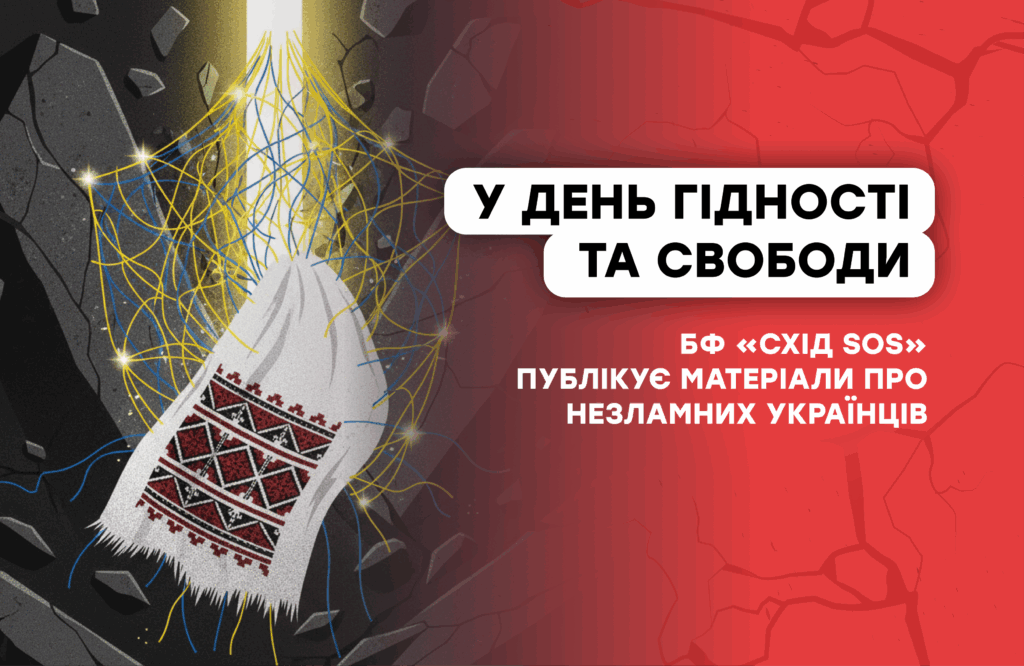
Every year on November 21, Ukraine marks Dignity and Freedom Day. This date honors the courage of citizens who once gathered on the streets of their hometowns.
During wartime, human dignity becomes especially visible, as a force that helps you survive and not lose yourself. It emerges through everyday choices: supporting a neighbor, refusing to abandon one’s principles, remaining humane amid fear and uncertainty.
For the East SOS Charity Foundation, this day holds particular meaning. The public initiative – later transformed into a foundation defending the rights of Ukrainians affected by russian aggression – was created by activists who stood in various cities during the Revolution of Dignity. Since 2014, the East SOS documentary team has been collecting evidence of potential war crimes committed by russia in Ukraine. During the full-scale invasion alone, the team conducted more than 1,000 interviews and documented 1,560 alleged crimes. To mark Dignity and Freedom Day, we share stories that prove: dignity endures even under immense pressure. These are stories of unity, resilience, self-sacrifice, love, and mutual support. For safety reasons, the names of respondents have been changed. All have left the temporarily occupied territories.
“People came to Maidan because it was about democratic values, dignity, the desire to be themselves, and the defense of their rights and freedoms. After Maidan – or rather, during it – we saw russia aggressively interfere with our right to be who we are. And when you face such aggression, you understand that you cannot stay silent. You must speak out and affirm that there are forces capable of defending Ukraine and the right to be Ukrainian,” says Liudmyla, a teacher from Vuhledar. She managed to leave her hometown in early March 2022.
Dignity in times of war is the readiness to sacrifice, the ability to consciously place the safety and lives of others above one’s own fears and comfort. One respondent described the courage of State Emergency Service workers who continued performing their duties during the battle for Popasna in 2022:
“All SES units on the ground continued to work and respond despite the danger, risking their lives. I honor and respect such people. They responded to every call and did everything they had to do – everything they could do,” recalls Serhii from Popasna.
The willingness to help others even when your own life is at risk is one of the greatest demonstrations of Ukrainian courage:
“On March 2 (2022), the shelling intensified, and we couldn’t leave the house. We kept moving when possible, but the attacks didn’t stop. Popasna is a small town, and it was being hit constantly – mortars, multiple rocket launchers, everything. I arrived by bus with a driver who was evacuating people and took the bus that had been locked in a garage in Popasna. I managed to rescue a family – a husband, wife, their daughter, and a cat. I also evacuated an elderly man,” says Yaroslav from Popasna.
During the war, volunteers became the backbone of both the state and society. Their work has been essential to the survival and resilience of entire communities:
“On February 24, my husband and I woke up, like the whole country, to learn about the russia’s full-scale invasion. Since we had been volunteering and actively involved in our community since 2014, we already had an action plan in mind for what we needed to do. At 9:00 a.m. that same day, we gathered at the free space ‘Khalabuda’ in Mariupol, a 300 m² community hub. All our friends, who had been volunteering with us for years, came as well, along with active residents of Mariupol, individual volunteers, and initiative groups. Together, we began deciding how to act. We divided responsibilities: What should we do in the city? Should we leave or stay? If we stay, who stays and in what roles? How can we help the local residents? We began setting up warehouses based on Khalabuda and transformed the educational space into a volunteer center as much as possible. Mariupol residents brought warm blankets, food, and water,”says Liudmyla from Mariupol.
War is a time when people need one another, when they long to hear words of support and warmth. Due to the ongoing danger from Russia, many schools have been relocated or operate online, leaving communities feeling fragmented:
“When you hold a meeting – be it a teachers’ council or any informational gathering – everyone tries to make eye contact with you. They want to hear words of encouragement. During holidays, meetings, and conferences, our colleagues often ask, ‘Could we have five minutes just to feel at home?’ We truly cherish these moments, share memories of happier times, and plan for the future. Meetings tend to last longer and longer because of this. It is important not only to hear from those working offline, but also to remember that we still exist – no one has closed us down yet,” says Anna, Acting Director of Siverskodonetsk Gymnasium No. 4, from Siverskodonetsk.
Although Anna had to leave her hometown and the occupiers destroyed the school’s premises, the gymnasium continues to function online thanks to the dedication of its staff, who relocated to government-controlled territory.
Often, people tried to save their most precious belongings – items that carry the symbols of the nation: embroidered shirts, towels, and other heirlooms representing memory, roots, and the right to be themselves.
“We buried some things. I thought I could take an embroidered towel from my backpack and an embroidered shirt from Kolomyia that a friend had bought me. But we heard from those who had already left that anyone found with symbolic items wasn’t seen again, so we had to leave them behind. That’s what we regretted most, both my husband and I – not the house itself. We realized there might be nowhere to return to, as the war was still ongoing, so we had to let go of everything at once. We had already lost it. My son regrets his books the most, while my embroidered towel is probably the most precious thing for me. At least I was able to take the gerdans with me,” shared Svitlana from Pavlivka village, Donetsk region.
Svitlana’s family was forced to flee the Donetsk region due to russian aggression, and they suffered the painful loss of their pet – a symbol of home and familiar life. Despite their own fear and uncertainty, they later rescued an abandoned kitten, demonstrating the ability to remain humane even in the most challenging circumstances.
“There was an episode that stayed with us for a long time. It happened on the road in the Kirovohrad region. Later, we turned to volunteer organizations for help, posting on social media: ‘We lost our cat, who slept on my head in the basement for 90 days; it was a favorite animal.’ On the bus, it ran away while we were trying to take it to the toilet. The whole bus searched for it, but we couldn’t find it. All three of us cried when we arrived in Kyiv – it felt like a real loss. I remember saying, ‘I don’t feel sorry for the house, but the cat is the last straw.’ Then, when we had the opportunity to rescue a kitten of the same color that was about to be abandoned, we took it. Now it sits here, playfully biting my hand,” shared Svitlana from Pavlivka village, Donetsk region.
The documentation of war crimes by East SOS is carried out as part of the project “Support for War-Affected Vulnerable Populations and Residents of Remote Areas of Ukraine”, with financial support from the European Union. Its content is the sole responsibility of the foundation and does not necessarily reflect the position of the EU.