Admission Campaign for Youth from the Temporarily Occupied Territories 2025: Results and Challenges
During the 2025 admission campaign for young people from the temporarily occupied territories (TOT), the East SOS Charity Foundation carried out extensive informational, educational, and advisory work. Our goal was to ensure that as many prospective applicants from TOT as possible were aware of the available opportunities and benefits, and could enter Ukrainian educational institutions without unnecessary barriers.
As this year’s admission campaign has now concluded, we would like to share the results and reflect on the key lessons learned.
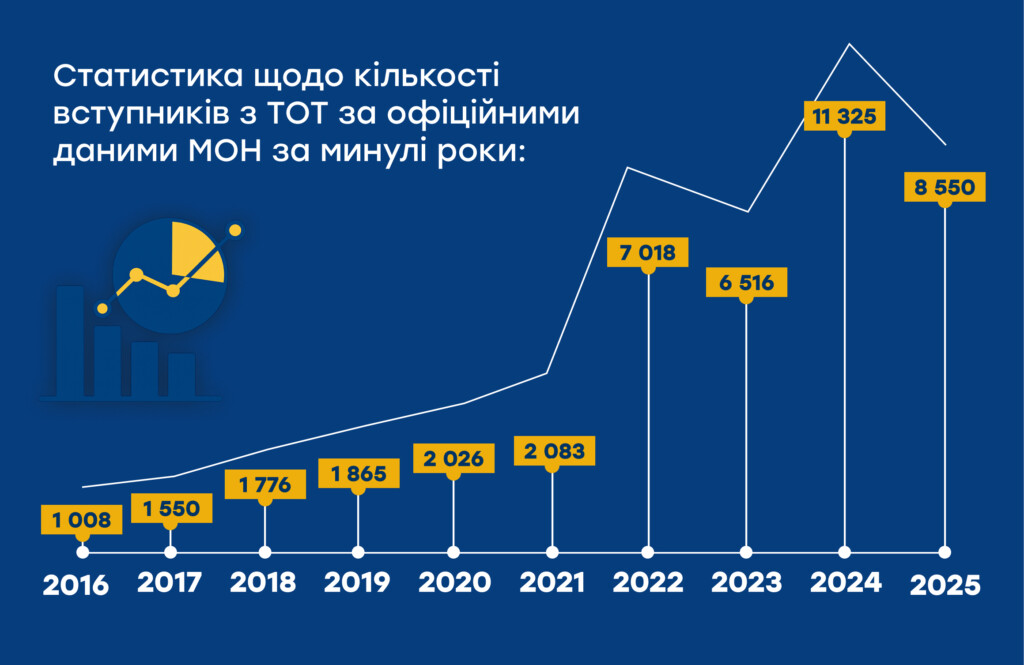
In 2025, a total of 8,550 people from the temporarily occupied territories (TOT), territories of active hostilities (TAH), and those who had relocated from these areas during the year were enrolled in Ukrainian higher and vocational education institutions. This figure includes students admitted to both state-funded and tuition-based programs.
Although last year saw an upward trend in the number of applicants from TOT and TAH entering Ukrainian institutions, the 2025 data shows a decline. This indicates that Ukraine has “lost” a portion of its young people currently living under temporary occupation.
Below are the official Ministry of Education and Science statistics on the number of applicants from TOT over previous years:
The main challenges and obstacles that young people from the temporarily occupied territories face when trying to obtain a Ukrainian education include:
- Deteriorating security conditions due to the prolonged and intensified full-scale war.
- Limited access to reliable information about simplified admission procedures for people living in TOT.
- Severe difficulties leaving the occupied territories.
- Financial constraints that complicate relocation.
- Pressure, intimidation, and security risks within the TOT, including threats from the occupation authorities.
- Forced attendance at russian-controlled schools and bans on studying in Ukrainian educational institutions imposed by the occupiers.
- Significant educational losses, particularly gaps in subjects related to Ukrainian studies and language.
- High stress levels and difficult psychological conditions.
- The influence of russian propaganda and the occupation regime, including attempts by the aggressor state to isolate Ukrainians from the national informational and cultural space.
- Limited Internet access and restricted availability of preparatory materials for admission.
- Insufficient state-level measures to maintain ties with Ukrainians under occupation and to create additional conditions for their admission, relocation, integration, and adaptation.
Throughout the admission campaign, East SOS specialists responded to inquiries from prospective applicants, their relatives, and teachers regarding opportunities to enter Ukrainian educational institutions and provided assistance in resolving these issues. This year, the most frequent inquiries concerned:
- Possibilities for admission without the National Multi-Subject Test (NMT).
- Admission procedures under Quota-2.
- Opportunities for online admission and subsequent distance learning for those who remain in the TOT.
- Whether applicants from TOT can enter any higher education institution in Ukraine or only specific ones.
- Details of the simplified admission procedure for applicants from TOT and TAH.
- Possibilities for entering master’s programs.
- Assistance in selecting a suitable university for a child from TOT.
- Operation of “Crimea–Ukraine” and “Donbas–Ukraine” educational centers at HEIs (schedules, contacts, and procedures).
- Online admission after 9th grade for young people from TOT.
- Procedures for obtaining a document on general secondary education.
- Obtaining a Ukrainian passport.
- Support for young people who left the occupied territory independently, without parents.
- The list of required documents for admission.
- Difficulties and challenges in interacting with educational centers.
One of those who reached out to East SOS specialists was Kateryna, a deputy director of a community school located in the temporarily occupied territory. Although the school itself had been relocated to a government-controlled area, most students remained in the TOT and were unable to leave for various reasons. The children continued their studies remotely, while teachers in the government-controlled territory took part in a series of East SOS webinars and supported their students throughout the enrollment process.
Kateryna assisted one of her graduates, Sofiia, who asked for help. After receiving clarification on all necessary steps, Sofiia applied to the educational center at her chosen university to take entrance exams in the form of interviews in the required subjects. She expected to be admitted through the simplified procedure available to applicants from TOT. However, at this stage she faced obstacles: the educational center informed her that she would need to apply in September and take exams for admission on a contract (tuition-based) basis, with the possibility of transferring to a state-funded program later.
Kateryna and the East SOS specialists contacted the educational center and explained the admission procedure for young people in similar circumstances. Eventually, the issue was resolved: Sofiia was enrolled in a state-funded program through the simplified procedure, completing her exams on time and successfully. She is now studying psychology at a Ukrainian university and is sincerely grateful to be a student of a Ukrainian institution — she never even considered any other option.
Kateryna believes that the enrollment of young people from TOT should not rest solely on the applicant’s shoulders; rather, it requires cooperation between the student, the school, educational centers, and civil society organizations.
“I am a teacher myself from a territory that is now occupied, and I understand how important it is not to leave children alone with their problems. They study and live in constant fear; none of them is to blame, and none of them expected the russians to come. Many who remain there truly cannot leave, and they are very happy when they know they are remembered and that people want to help them,” she says.
In 2025, East SOS — together with its partners — actively supported the admission of young people from the temporarily occupied territories. Key activities and achievements included:
- A series of webinars for teachers working with children from the TOT on admission to Ukrainian higher and vocational education institutions — 3,199 participants.
- The webinar “Digital Safety for Teachers Teaching Children from the Temporarily Occupied Territories” — 224 participants.
- A webinar for authorized representatives of secondary education institutions on issuing documents on basic or complete secondary education for the purpose of university admission for applicants from TOT — 106 participants.
- Distribution of information materials on admission opportunities and rules for people from TOT and TAH. These materials were disseminated in frontline communities and through the “Crimea–Ukraine” and “Donbas–Ukraine” educational centers at higher education institutions — 146 sets.
- A focus group with educators working with children in the TOT, enabling the foundation to gather insights into the challenges these children face.
- Updating and significantly expanding the foundation’s dedicated information website on admission from TOT.
- Operation of a legal hotline throughout the admission campaign, which received and processed 59 inquiries from applicants, parents, and educators, providing consultations, support, and clarifications.
- A communication campaign was carried out to raise awareness about admission opportunities for people from the TOT. Numerous publications were shared across the foundation’s platforms, and more than five media interviews and expert commentaries were organized — including for Ukrainian Radio, RBC-Ukraine, and the online outlet Eastern Variant.
We are grateful to all our colleagues and partners for their cooperation and dedication to expanding access to education for people from the temporarily occupied territories. This year, we worked closely with the Ministry of Education and Science of Ukraine, the Ukrainian Parliament Commissioner for Human Rights, the Ministry of Community and Territorial Development of Ukraine, the Mission of the President of Ukraine in the Autonomous Republic of Crimea, higher and vocational pre-higher education institutions, general secondary education institutions, as well as Almenda, Bring Kids Back UA, ZNOVU, MINZMIN, Donbas SOS, and Krymsos. We also extend our thanks to our colleagues from the Ukrainian Child Rights Network, Helping to Leave, Save Ukraine, and the State Enterprise “Reintegration and Recovery” for their invaluable work.
All these institutions, foundations, and organizations — and many others — are doing tremendous work to ensure that young people from TOT have a real opportunity to receive a Ukrainian education and to access it without obstacles. At the same time, current figures and insights demonstrate that continuous efforts are needed at every level to protect citizens living under temporary occupation and to guarantee their right to Ukrainian education.
*All names have been changed for security reasons.
The advocacy activities described are carried out within the project “Support for War-Affected Vulnerable Groups and Residents of Remote Areas of Ukraine”, implemented by East SOS with financial support from the European Union.
Recently, East SOS shared a story of Konotop educators who are fostering hope and faith in the future while teaching children in school shelters.